
NeoSmelt brings together the expertise of BHP, BlueScope, Mitsui Iron Ore Development, Rio Tinto and Woodside Energy to investigate the proposed development of the country’s largest ironmaking Electric Smelting Furnace (ESF) pilot plant.



A unique collaboration between industry and government to decarbonise steelmaking
Why is it important to decarbonise iron and steel production?
The Pilot Plant
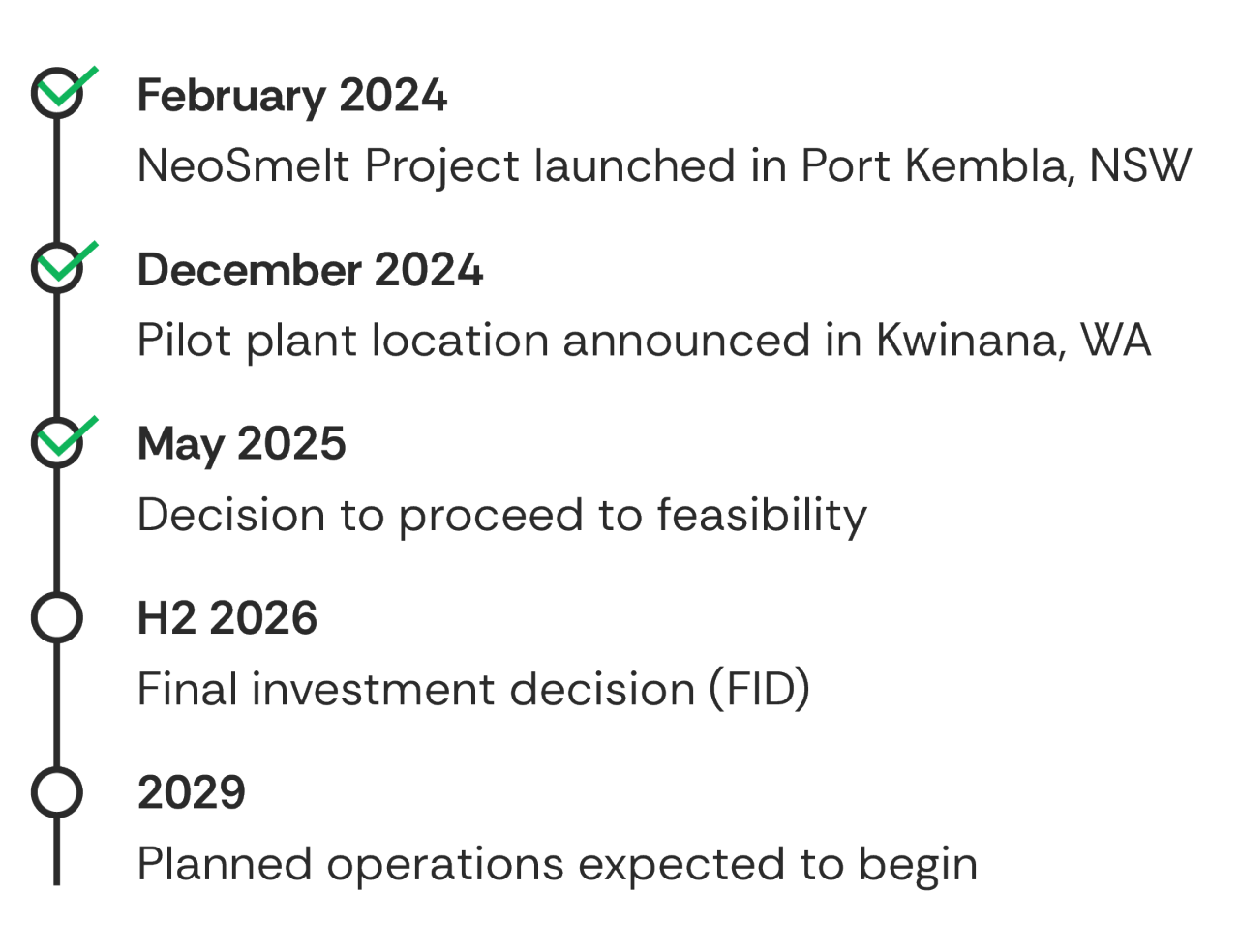
The proposed NeoSmelt pilot plant on the Western Trade Coast, Perth would produce 30,000 to 40,000 tonnes of molten iron a year with operations planned to begin in 2029.
Utilising hydrogen in the DRI-ESF process route, when combined with renewable electricity, has the potential to reduce the greenhouse gas (GHG) emissions associated with ironmaking (the precursor to the manufacturing of steel and the source of most of the emissions associated with such manufacturing) by ~80% when compared with blast furnace produced iron.4
The Direct Reduction Plant (DRP) would initially use natural gas to reduce GHG emissions when processing iron ore into DRI, but once fully operational, the project aims to also trial hydrogen to process iron ore into DRI. By replacing the natural gas with lower-carbon5 hydrogen we expect near zero GHG emissions6 ironmaking is possible.
If successful, the pilot could enable the proliferation of industrial scale DRI-ESF into existing and new customer markets to accelerate a pathway to near zero emissions6 intensity steelmaking utilising Australia’s Pilbara ores.
How the DRI-ESF works
Iron ore is converted into DRI using natural gas or hydrogen as a reductant. DRI is charged into the ESF, removing the remaining impurities as a slag product to produce iron suitable for the basic oxygen steelmaking process. NeoSmelt’s DRP technology is to be supplied by Tenova and its ESF technology is to be supplied by Hatch.

Project Timeline

JV Participants
Engineering Vendors
Acknowledgement and Disclaimer
Acknowledgement
The Project received funding from the Australian Renewable Energy Agency (ARENA) as part of ARENA’s Industrial Transformation Stream Program.
Disclaimer
The views expressed herein are not necessarily the views of the Australian Government and the Australian Government does not accept responsibility for any information or advice contained herein.

Get Involved with Project NeoSmelt
We welcome enquiries from stakeholders, industry leaders and innovators who share our vision for lower-emission steelmaking. Whether you are interested in collaboration, technical insights or investment opportunities, our team would be glad to connect.
- Compared to the conventional blast furnace – basic oxygen furnace (BF-BOF) process.
- Rio Tinto (2024), A new way to decarbonise steelmaking. https://www.riotinto.com/en/news/stories/decarbonising-steel-making .
- Government of Western Australia, Department of Jobs, Tourism, Science and Innovation, WA Iron Ore profile – May 2025, accessed 1 September 2025.
- Assumes utilisation of renewable energy to power the DRI-ESF facility and zero emissions hydrogen in the DRI plant. Utilising natural gas as the primary reductant has the potential to reduce GHG emissions by ~60% when compared with blast furnace produce iron.
- Lower-carbon has the characteristic of having lower levels of associated potential greenhouse gas emissions when compared to historical and/or current conventions or analogues, for example relating to an otherwise similar resource, process, production facility, product or service, or activity.
- ‘Near zero emissions’ for steelmaking is 0.40 tonnes of CO2-e per tonne of crude steel for 100% ore-based production (no scrap), as defined by the International Energy Agency (IEA) and implemented in Responsible Steel International Standard V2.0 (‘near zero’ performance level 4 threshold). IEA (2022), Achieving Net Zero Heavy Industry Sectors in G7 Members, IEA, Paris, License: CC BY 4.0, which also describes the boundary for the emissions intensity calculation (including in relation to upstream emissions).

